
In the French Pyrenees, an entire community shares our burdens
A columnist and her daughter travel to the Sanctuary of Our Lady of Lourdes
Written by |




There is a story that brings 5 million visitors each year to a hamlet nestled in the foothills of the majestic Pyrenees. Lourdes, France, has a population of only about 15,000, but massive crowds of pilgrims have flooded the town since 1858, when news spread of an apparition of the Virgin Mary and a spring of water given for healing.
The story comes from Bernadette Soubirous, an illiterate 14-year-old girl from a family in dire poverty. Despite harassment and threats, Bernadette didn’t change a single detail of her testimony. She said that while searching for firewood in a cave just outside town, she saw the most beautiful lady imaginable, and on 18 occasions, this mother from heaven spoke messages of love, hope, and healing.
On one historic day, Bernadette, listening to the words of the lady, dug in the ground where she was told. To the surprise of hundreds of spectators, water later welled up from beneath the surface. For centuries since then, miracles of healing have been documented by pilgrims who traveled to that site to honor the heavenly mother and her son and to wash in the waters of the healing spring.
Healing waters and congregation
At the beginning of every May, the infirm from all over the globe are brought to Lourdes on a pilgrimage organized by a group called the Order of Malta. This lay Catholic religious order has existed to serve the poor and sick in Christ’s name for over 900 years.
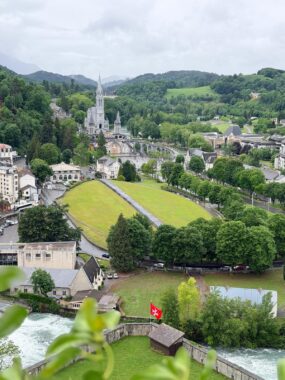
A view of the Esplanade of the Sanctuaries at the heart of the Sanctuary of Our Lady of Lourdes in the French Pyrenees. (Photo by Steve Chetcuti)
My daughter, Marisa, who has Fabry disease, was selected to be one of the patients brought to Lourdes this year by the Order of Malta, and I had the privilege of accompanying her. We stayed in an elegant 19th-century hotel room with a balcony, and volunteers escorted us daily to the sanctuary just steps away from our accommodations. Being immersed in history, beauty, serenity, and worship was life-giving, and we will never forget how beautifully we were loved by a group that started out as strangers and ended as family.
My older two sons were awarded wishes from the Make-A-Wish Foundation when they were diagnosed with Fabry, but Marisa was not. Yet, like them, she suffers from neuropathy, gastrointestinal issues, inexplicable fevers, and overheating. So, when she was granted this all-expenses-paid pilgrimage, we accepted it as a delightful consolation from God.
Being at Lourdes felt grandiosely universal and intimately personal at the same time. The shrine has arms wide open to people of every culture, age, religion, and disability. The diversity was amazing. Prayers were offered all day in multiple languages, and pilgrims came by foot, wheelchair, scooter, or stretcher, each with a story of their own. Though I was one of thousands who arrived at the grotto weighed down with a long list of troubles, I felt seen and my prayers heard.
In one poignant moment, I witnessed a multitude of Order of Malta members specifically praying for my daughter and me. Tears flowed as I realized we had a whole community there to share our burdens, and my load became lighter. So, like millions of others who have prayed and washed at Lourdes, I experienced a mighty grace that can heal both body and soul.
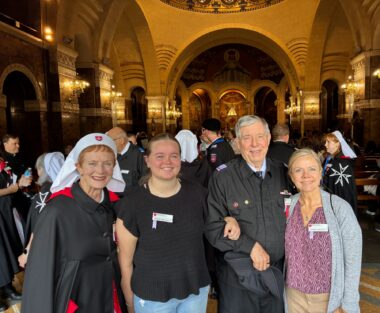
From left, the Order of Malta’s Sheila Wiefford, Marisa VanVickle, the Order of Malta’s Tom Wiefford, and columnist Susanna VanVickle share a moment at the Basilica of Our Lady of the Rosary in Lourdes, France. (Courtesy of Susanna VanVickle)
English author Philip Pullman wrote that “after nourishment, shelter, and companionship, stories are the thing we need most in the world.” The group we traveled with can attest to the impactful power of stories. Our hearts were moved as we heard each other’s tales of suffering and overcoming. So many people we passed in the sanctuary were there because of an illness, a rare disease, a disability, or a trauma that I don’t know or understand, and even though I didn’t get to hear their stories, their presence left a lasting imprint on my heart.
Bernadette’s story includes these words from heaven: “I do not promise to make you happy in this world but in the other.” My faith is bolstered by this message. Suffering is inescapable in our earthly life, but I hope in the promise that we are made for more. I believe that the stories of my family’s Fabry disease, of the paraplegic, and of the child who has been given months to live were not written with a tragic ending. I trust that the author of life is writing a love story for each of us that ends in a happily-ever-after union with him, where no tears or pain remain.
For the moment, I am enjoying the cathartic nature of telling my story in this column. Our stories matter. Your story matters. Consider sharing yours through a Fabry support group or connect with me at [email protected] to tell it here.
Note: Fabry Disease News is strictly a news and information website about the disease. It does not provide medical advice, diagnosis, or treatment. This content is not intended to be a substitute for professional medical advice, diagnosis, or treatment. Always seek the advice of your physician or other qualified health provider with any questions you may have regarding a medical condition. Never disregard professional medical advice or delay in seeking it because of something you have read on this website. The opinions expressed in this column are not those of Fabry Disease News or its parent company, Bionews, and are intended to spark discussion about issues pertaining to Fabry disease.

Leave a comment
Fill in the required fields to post. Your email address will not be published.