
I work hard to influence my health outcome with Fabry disease
I do everything I can to maintain optimal health and well-being
Written by |





For more than 20 years, I’ve had stage 3 chronic kidney disease. My Fabry disease also resulted in progressive heart failure, necessitating a heart transplant in 2020. I believe that receiving enzyme replacement therapy for nearly 23 years has kept my kidney disease from progressing to stage 4. With my heart transplant, my kidney disease improved to stage 2/3, a reversal rarely experienced by people like me.
Despite the improvements I’ve experienced, Fabry is a progressive disease. As I previously mentioned in a column about lower leg edema, my blood pressure has been trending higher, and my urine albumin-creatinine ratio and protein-creatinine ratio have been increasing, indicating a decline in kidney function. As a result, I was prescribed a 20 mg nightly dose of Micardis (telmisartan), an angiotensin II receptor blocker (ARB). Taking an ARB or an ACE inhibitor as a supplemental therapy is common among people with Fabry.
The 20 mg dose was not effective, so my nephrologist increased it to 40 mg. At a follow-up appointment a couple of weeks ago, he was concerned that my lab ratios weren’t improving enough, and my blood pressure was still frequently around 130/90 mmHg. He increased my nightly dose to 80 mg, the maximum recommended dose for me.
The 80 mg dose has improved my kidney ratios sufficiently, which is excellent, but my blood pressure still fluctuates between 120/80 mmHg and 130/90 mmHg or higher. I’ve learned from experience that adequate exercise can help lower my blood pressure, though exercise alone isn’t enough to keep my levels normal. I hope the combination of the ARB and exercise will prevent my blood pressure readings from becoming too high. As always, time will tell.

Taking control where possible
A couple years ago, I adopted the hashtag #InfluenceYourFabryOutcomes personally and on behalf of the National Fabry Disease Foundation (NFDF), the organization I started and have managed for 20 years. The scenario above is just one example of what this hashtag means to me. Each time I experience an adverse health outcome or encounter an obstacle to achieving optimal health, I strive to find a solution.
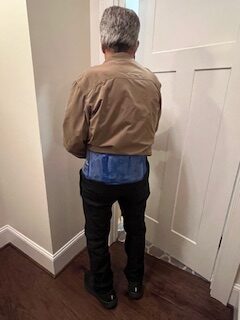
Jerry Walter wears an ice pack belt to alleviate pain. (Courtesy of Jerry Walter)
As I wrote last June, Fabry progression and advancing age often pose new obstacles to maintaining optimal health.
During a recent webinar, a guest panelist with Fabry disease shared his version of #InfluenceYourFabryOutcomes. “I give myself every opportunity to win,” he noted. Like me, this panelist says he tries to do everything possible to maintain optimal health. He emphasized that mental health is also a crucial component of the formula.
(I’ll take this opportunity to remind my readers about the NFDF’s 24/7, cost-free counseling services through the Family Assistance Program.)
Last month, I turned 71, an age I never expected to reach as someone with classic Fabry disease. I’m sure my life will continue as usual, with some bumps along my road less traveled, but hopefully, I can easily overcome any future challenges I face.
This month’s new challenges include my right hand temporarily locking up when I type, which I just discovered while writing this column. It’s probably unrelated to Fabry, but I’ll make an appointment with an orthopedic hand specialist to have it checked out.
My continuing challenges — mostly unrelated to Fabry, I think — include receiving recurring epidural steroid injections and new medial branch block injections before I schedule ablation therapy to deaden the nerves causing the pain. I’ve been diagnosed with numerous spine issues, including cervical radiculopathy, lumbar radiculopathy, sciatica, spondylosis, and sacroiliitis. Along with the injections, I have an at-home physical therapy program, take limited pain medications as needed, and use a wearable ice pack. If I can manage my back pain effectively, I can continue to improve my overall health.
Everyone with Fabry has a different story, and I’m sorry for those who struggle to manage their symptoms and overcome the obstacles they face. I wish everyone the best possible health as we fight Fabry and work toward better, longer lives!
Note: Fabry Disease News is strictly a news and information website about the disease. It does not provide medical advice, diagnosis, or treatment. This content is not intended to be a substitute for professional medical advice, diagnosis, or treatment. Always seek the advice of your physician or other qualified health provider with any questions you may have regarding a medical condition. Never disregard professional medical advice or delay in seeking it because of something you have read on this website. The opinions expressed in this column are not those of Fabry Disease News or its parent company, Bionews, and are intended to spark discussion about issues pertaining to Fabry disease.


Diane Rothman
Jerry, you are always an inspiration! When I want to slack off on my exercises, I think of you and grit my teeth and get on with it. Thank you.
Janice
Well done! Amazing how you have done…
Im just a little confused when you talk about your blood pressure reading fluctuating, as they seem pretty normal to me (as it’s normal to fluctuate during the day).I’m not a Dr ,but I think it’s seems fine to me. 🤗