Fabry disease in women
 Fact-checked by
 Fabry disease, a rare genetic disorder, was previously believed to affect only men. However, recent research has shown that women can experience Fabry in many of the same ways as their male counterparts.
The symptoms of Fabry in women are highly variable, and there’s still a low clinical awareness about the disease in female patients. This means that women with Fabry disease remain underdiagnosed and undertreated relative to their male counterparts.
How Fabry disease is inherited in women
Fabry disease is caused by mutations in the GLA gene, which is located on the X chromosome. Females are born with two X chromosomes and males with one.
Fabry disease is generally passed down from parents to their biological children in an X-linked manner. Boys and men will develop Fabry symptoms if they inherit the disease-causing mutation on their only X chromosome.
X-linked Fabry disease in women is a bit more complex. Women who inherit a mutated copy of GLA from one parent will usually inherit a healthy copy from the other. This healthy version of the gene can help compensate for problems caused by the mutated one, but the degree to which it does so is highly variable.
This is likely due to a natural process called X-chromosome inactivation, in which each cell in the female body randomly “turns off” one X chromosome and leaves the other one active. The proportion of cells carrying the mutated GLA copy, and where these cells are located in the body, influences the likelihood that a woman will experience Fabry disease carrier symptoms.
While some women with one GLA mutation are considered asymptomatic carriers, studies show that at least two-thirds will experience Fabry symptoms.
Common symptoms of Fabry disease in women
The symptoms of Fabry disease in females vary, but as in men, nearly all organs and body systems can be affected. Some common symptoms may include:
- pain and sensory symptoms: nerve pain, hearing loss, and eye-related issues
- skin, sweating, and temperature issues: noncancerous skin bumps (angiokeratomas), sweating problems, and overheating
- digestive symptoms: abdominal cramping or pain, nausea, vomiting, diarrhea
- heart symptoms: abnormal heart rhythms, thickening of heart muscles
- kidney symptoms: urinary changes, proteins in the urine
- brain and nervous system symptoms: strokes or “mini-strokes”
Pain and sensory symptoms
Fabry disease pain in women is often related to nerve damage and may commonly include episodes of numbness, tingling, or burning sensations in the hands and feet (acroparesthesias). Such pain may be among the earliest signs of Fabry in women.
Many people with Fabry experience eye-related changes, with the most common being corneal verticillata — a starburst-like pattern of cloudy areas on the surface of the eye. Vision and hearing loss are also possible.
Skin, sweating, and temperature issues
Angiokeratomas appear as rough, dark red to black bumps on the skin — often on the trunk, genitals, or upper legs. The growths aren’t cancerous or harmful.
Damage to the autonomic nervous system, which controls involuntary bodily processes, can also cause women with Fabry to sweat less than normal. This can mean that they become easily overheated or develop a fever.
Digestive symptoms
Gastrointestinal symptoms — such as abdominal cramping, nausea, diarrhea, and vomiting — can also be early signs of Fabry disease in women and in younger girls.
Heart symptoms
Heart problems are common in women with Fabry, although they don’t always cause obvious symptoms.
Often, the first sign of Fabry disease heart problems in women is an abnormally slow heartbeat, but more serious problems can develop over time. As heart disease becomes more severe, symptoms of heart failure, such as shortness of breath, chest pain, and fatigue, can manifest.
Cardiovascular disease can substantially impact life expectancy and is the leading cause of death for women with Fabry disease.
Kidney symptoms
Kidney problems are also common in women with Fabry disease, although they don’t occur as often as they do in men.
These problems can initially manifest as high levels of proteins in the urine, but may later cause issues such as changes in urinary frequency and appetite, swelling, or muscle cramps. Progressive kidney issues can lead to end-stage kidney disease.
Brain and nervous system symptoms
The risk of stroke in women with Fabry disease is higher than in the general population. Strokes and transient ischemic attacks, known as “mini-strokes,” can cause serious brain damage.
Sensory symptoms, pain, and digestive problems are often signs of damage to other parts of the nervous system.
Why Fabry disease can be different for women
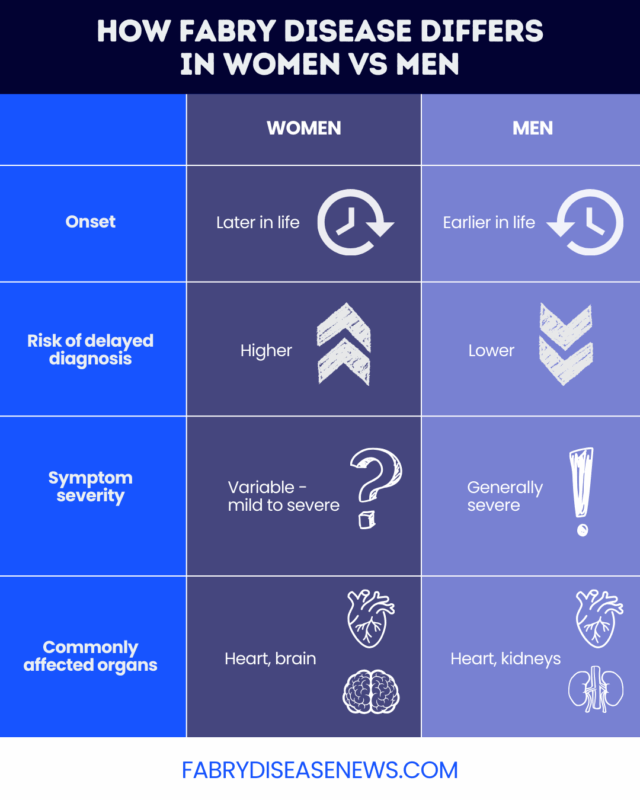
While women with Fabry disease can experience any of the symptoms that their male counterparts do, the pattern and presentation can be different.
- Women often begin experiencing symptoms later in life, although it is possible for symptoms to occur at any age, including childhood.
- Symptoms tend to take a more standard and severe course in men, while they are more variable in women.
These factors, plus low awareness of the disease among clinicians, make diagnostic delays particularly common in female patients. This is a problem because a late diagnosis of Fabry disease gives more time for irreversible organ damage to accumulate without treatment.
The risk of potential complications that occur as Fabry progresses, such as heart failure and stroke, may be underestimated in women because of the misconception that the disease always takes a milder course in female patients. Thus, women with Fabry are also commonly undertreated even after diagnosis.
How Fabry disease is diagnosed in women
Diagnosing Fabry disease in women can be challenging. In men, a very reliable diagnostic test measures the activity of alpha-galactosidase (alpha-Gal A), the enzyme that’s affected by GLA mutations, in a blood sample.
However, some women can have normal alpha-Gal A activity in the blood due to X-inactivation patterns, even if they have a substantial disease burden. As such, genetic testing for Fabry disease in women is usually required to establish the diagnosis. These tests are designed to detect disease-causing mutations in the GLA gene.
It’s key for women with suspected Fabry or a known family history of Fabry to see a specialist with the expertise to diagnose the disease appropriately. Proactive monitoring, combined with genetic testing, can help diagnose the condition even before symptoms become apparent.
Treatment options for women with Fabry disease
Fabry disease treatment for women is focused on slowing disease progression and delaying or preventing severe organ damage. Although most clinical trials are focused on men, approved Fabry treatments, including enzyme replacement therapies (ERTs) and chaperone therapies, can also be effective in women.
Current guidelines recommend initiating ERT for Fabry in women when the earliest signs of Fabry-related organ damage become evident. Regular monitoring is crucial for detecting silent disease progression. However, data show that women with Fabry remain undertreated relative to their male counterparts.
In addition to treatments that target the causes of Fabry disease, supportive therapies and lifestyle interventions can help ease specific symptoms, including:
- pain: medications, physical and occupational therapy
- heart or kidney problems: medications, lifestyle changes
- digestive problems: medications, dietary changes
Women should work with their healthcare team to develop an individualized treatment plan tailored to their specific needs.
Pregnancy, family planning, and Fabry disease
Women with one mutated copy of the GLA gene have a 50% chance of passing the disease-causing mutation to any biological child. Genetic counselors can help potential parents understand this risk and explore family planning options for Fabry disease.
Although there is limited research about Fabry disease and pregnancy, studies suggest that some symptoms can worsen during pregnancy. Treatment adjustments may have to be made, as not all medications will be safe to take during pregnancy or breastfeeding.
Daily challenges of Fabry disease for women
Fabry disease can significantly impact daily life for women, but taking certain precautions and making lifestyle adjustments can be beneficial. For example, pacing activities and incorporating rest periods can help prevent triggering fatigue in women with Fabry disease. Planning can also help prevent exposure to extreme temperatures.
Living with Fabry disease as a woman comes with unique emotional and social challenges, which may lead to depression, anxiety, loneliness, or stress. Tailored mental health support, such as counseling or peer support groups, can help women cope with the burden of Fabry disease in everyday life.
Fabry Disease News is strictly a news and information website about the disease. It does not provide medical advice, diagnosis, or treatment. This content is not intended to be a substitute for professional medical advice, diagnosis, or treatment. Always seek the advice of your physician or other qualified health provider with any questions you may have regarding a medical condition. Never disregard professional medical advice or delay in seeking it because of something you have read on this website.