Jeff’s Journey With Fabry Disease
Sponsored and written by Chiesi USA based on interviews with Jeff, a Chiesi Patient Ambassador for Elfabrio® (pegunigalsidase alfa-iwxj), and published with his express permission. Jeff has been compensated by Chiesi USA.
Written by |





Individual results may vary. The information herein is general in nature and not intended to be a substitute for professional medical advice, diagnosis, or treatment. You are strongly encouraged to discuss any questions about Fabry disease with your doctor.
Please see Important Safety Information below, and full Prescribing Information, including Boxed Warning for severe allergic reactions including anaphylaxis, and Patient Information on elfabrio.com.
Jeff, a retired sergeant with his county sheriff’s office, was diagnosed with classic Fabry disease in 2003. Although he was 33 years old at diagnosis, his symptoms began at a much younger age. Read about Jeff’s journey to diagnosis, his experience living with Fabry disease, and his treatment with Elfabrio.
At just 8 years old Jeff began to experience what he describes as a burning sensation in his hands and feet—constant discomfort that was both painful and unpredictable. Sometimes this symptom just happened spontaneously; other times it was the result of some type of exertion. It was not until many years later that he would discover the underlying cause: Classic Fabry disease symptoms appear during childhood or the teenage years and get progressively worse over time.
At the age of 18, Jeff learned he had high blood pressure, which he still deals with today. Despite his health challenges, at age 21 Jeff followed his father into a career in law enforcement. At 22, when his feet and legs started to swell to the point he was having difficulty tying his shoes, Jeff was thought to have Milroy’s disease, a form of lymphedema. Jeff wore compression socks to manage the swelling in his feet and legs, which made him feel self-conscious in his new career.
In March 2003, Jeff was shown to be in kidney failure, and it was through a kidney biopsy that he finally received his diagnosis of classic Fabry disease. Jeff began dialysis in April of that year—3 days a week, 4 hours each day—and continued for 4 months. He then received a kidney transplant, with his father as the living donor, in August 2003.
Following his transplant recovery, Jeff began enzyme replacement therapy (ERT) for treatment of Fabry disease. On July 3, 2003, Jeff had his first ERT infusion—a treatment that would take place every 2 weeks for 7-8 hours each time. After experiencing an allergic reaction during treatment in 2011, premedication was added before each session, making his total infusion time even longer. His infusions required someone to drop him off and pick him up and were often followed by pain in the evening and a flushed face the following day.
Over the next 10 years Jeff continued to face additional health concerns, including daily gastrointestinal issues and some hearing loss. Then, in 2016, Jeff began having heart-related symptoms, including unexplained bradycardia, or slow heartbeat. In 2019, during an emergency room visit for difficulty breathing, Jeff was told he had a third-degree heart block, meaning the upper and lower chambers of his heart were no longer working together. To address this, Jeff received a pacemaker.
Despite the many medical challenges he experienced over the years, Jeff always remained optimistic. He continued to advance in his career in law enforcement and to grow his family. His health journey prompted discussions with family members that uncovered that some of them were also experiencing similar health issues and symptoms. Since Jeff’s diagnosis, 10 family members have also been tested for and diagnosed with Fabry.
Given the impact of Fabry disease on their family, Jeff and his wife have always been proactive about keeping track of and understanding advancements in Fabry disease—joining online Fabry communities and researching to see what progress was being made, especially regarding potential new treatments.
In January 2024, Jeff changed his treatment to Elfabrio, an ERT that was approved in 2023, indicated for the treatment of adults with confirmed Fabry disease. Prior to starting treatment, Jeff discussed with his doctor the common side effects such as common cold, headache, diarrhea, and fatigue as well as the potential for severe allergic reactions, including anaphylaxis (see elfabrio.com for more safety information). Almost 2 years into treatment with Elfabrio, Jeff reports that he is tolerating it well.
Jeff’s life today:
Over time Jeff was able to work with his doctor to reduce premedications and lower the duration of his Elfabrio infusions. Infusions now last about 90 minutes, with an additional 30 minutes for observation. Jeff is now retired, after having worked in law enforcement for almost 30 years, and enjoys staying active by working in a grocery store and fishing in a local creek. He’s proud to have been a part of the weddings for each of his grown children and is thrilled to be a grandfather, sharing his love of Matchbox cars, particularly police cruisers, with his grandsons.
About Fabry disease:
Fabry disease is a chronic, progressive genetic disease, caused by changes in the gene that makes alpha-galactosidase A (or alpha-Gal A), an enzyme that helps to break down a type of fat in the body. Buildup of this fat causes the symptoms associated with Fabry. Fabry disease does not go away on its own and it may get worse over time. With disease-specific treatment, it’s possible to slow the progression.
About Elfabrio:
Elfabrio is an enzyme replacement therapy approved to treat adults with confirmed Fabry disease. It is administered as an IV infusion every 2 weeks.
With an initial half-life of 78.9 ±10.3 hours, Elfabrio is long-lasting. It was designed using a process called PEGylation that extends its half-life, helping the treatment stay in the body longer between doses and increasing enzyme levels over time. Clinical studies have not shown that a long half-life results in a medicine working more effectively or more safely.
Clinical studies have shown that as the body becomes able to tolerate Elfabrio, the need for premedications may decrease. Also, with a health care professional’s consent, infusions may be transitioned from the clinic to home, after Elfabrio has shown to be tolerated and maintenance infusions have begun. Elfabrio offers people living with Fabry disease a treatment option to help manage this lifelong condition.
Indication and Important Safety Information for Elfabrio
Indication
Elfabrio® (pegunigalsidase alfa-iwxj) is a prescription infusion medicine used to treat adults with confirmed Fabry disease.
Important Safety Information
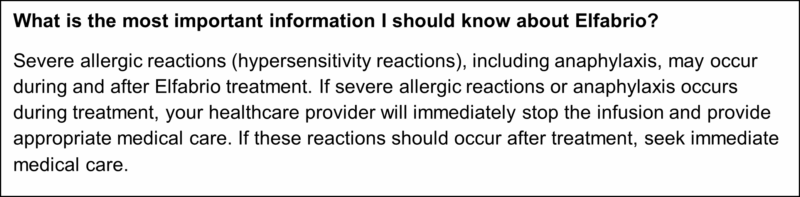
What should I know about Elfabrio infusions?
Your healthcare provider may give you other medications prior to your Elfabrio infusions to help manage allergic reactions and infusion-related side effects. They will explain how to recognize the signs and symptoms of these allergic reactions and infusion-related side effects. If these signs and symptoms occur, it’s important for you to seek immediate medical care. If the reaction is mild to moderate, your healthcare provider may choose to slow the infusion rate or withhold the dose.
In clinical trials, 41 patients (29%) experienced an infusion-related side effect. The most common signs and symptoms of an infusion-related reaction with Elfabrio were hypersensitivity, nausea, chills, itchy skin, rash, chest pain, dizziness, vomiting, feelings of weakness, pain, sneezing, shortness of breath, nasal congestion, throat irritation, abdominal pain, skin redness, diarrhea, burning sensation, nerve pain, headache, tingling or numbness, shaking movements, agitation, increased body temperature, flushing, slow heart rate, muscle pain, high blood pressure, and low blood pressure.
Your healthcare provider will do blood and urine tests to check your kidney function during treatment with Elfabrio.
The most common side effects of Elfabrio include infusion-related side effects, common cold, headache, diarrhea, fatigue, nausea, back pain, pain in the limbs, and sinus infection.
Please see full Prescribing Information for Elfabrio.
You are encouraged to report negative side effects of prescription drugs to the FDA. Visit www.fda.gov/medwatch or call 1-800-FDA-1088.
Learn more about Fabry disease and how Elfabrio may help you.
©Chiesi USA, Inc. 2025. All rights reserved.
Elfabrio® is a registered trademark of Chiesi Farmaceutici S.p.A.
PP-RA-01270 V1.0