
Understanding the significance of lyso-Gb3 in Fabry disease
Early treatment can help reduce lyso-Gb3 levels, prevent organ damage
Written by |





Every 10 to 11 days, I receive an infusion of one of the two enzyme replacement therapies (ERTs) approved in the U.S. to treat Fabry disease (FD). This is a little more frequent than usual, as most patients receive ERT every two weeks. November 2026 will mark 24 years since I started treatment.
After my heart transplant in 2020, I briefly experienced acute kidney failure due to the anti-rejection medicines I needed to take to protect my new heart. But after my transplant meds were adjusted and things settled down, my kidney function returned to what it had been before my transplant: stage 3 chronic kidney disease. My team then prescribed ERT more often to try to protect my kidneys.
Once a month, I have lab work done to measure my globotriaosylsphingosine, or lyso-Gb3, level. Lyso-Gb3 is a deacylated form of the fatty substance globotriaosylceramide (Gb3), meaning it lacks the fatty acid chain found in Gb3. Fabry disease is characterized by the toxic buildup of Gb3 and lyso-Gb3 in cells, which can damage organs and cause the symptoms of FD.

What our lyso-Gb3 levels mean
Lyso-Gb3 has been somewhat of a mystery to me, but as more literature is published, I am beginning to understand it better. A 2023 article published in the Clinical Journal of the American Society of Nephrology has been helpful.
The article describes a study in which plasma lyso-Gb3 levels were measured over time in 237 untreated Fabry patients (adults and children). The findings suggested that plasma lyso-Gb3 reaches a specific level in childhood and remains at that level over decades in patients with Fabry disease if an FD-specific treatment, such as ERT or oral chaperone therapy, is not initiated.
Researchers also found that higher levels of lyso-Gb3 were associated with the following:
- Steeper decline in estimated glomerular filtration rate, an indicator of kidney function
- Faster increase in albuminuria, a sign of kidney damage or disease
- Faster increase in left ventricular mass, a strong predictor of cardiovascular risk
- Faster increase in white matter lesions in the brain over time
A normal lyso-Gb3 level, according to the laboratory that processes my blood work, is 1 nmol/L or less. The study indicated that:
- Most untreated men and boys with classic FD had lyso-Gb3 levels over 40 nmol/L.
- Most untreated women and girls with classic FD had lyso-Gb3 levels between 2.3 and 40 nmol/L.
- Among those with nonclassic FD, most untreated male patients had levels between 1 and 40 nmol/L, while most untreated female patients had levels below 7.3 nmol/L.
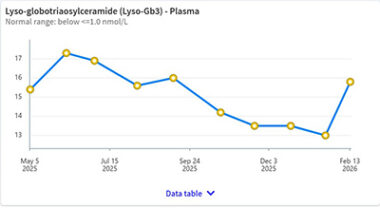
A snapshot of columnist Jerry Walter’s lyso-Gb3 levels between May 2025 and February 2026. (Courtesy of Jerry Walter)
I started ERT before lyso-Gb3 had been identified as a biomarker for FD, so I’ll never know how high my levels were before treatment. But most men with classic FD have high levels without treatment, as indicated above.
My lyso-Gb3 lab results since December 2016 are available on MyChart. Over the last year, my levels have ranged from 13 to 17.3 nmol/L, with last month’s report being 15.4 nmol/L. In the last nine years, I’ve missed two infusions. Afterward, my lyso-Gb3 level quickly doubled, but returned to my usual range once I got my next few infusions.
The most important thing I’ve learned from my attempts to better understand lyso-Gb3 is that early treatment is crucial to preventing organ damage and living a better, longer life with FD.
To further demystify lyso-Gb3, the National Fabry Disease Foundation, which I founded and serve as president, is hosting a webinar at 7 p.m. Eastern time on May 6. More information is available on our webinar series website.
Note: Fabry Disease News is strictly a news and information website about the disease. It does not provide medical advice, diagnosis, or treatment. This content is not intended to be a substitute for professional medical advice, diagnosis, or treatment. Always seek the advice of your physician or other qualified health provider with any questions you may have regarding a medical condition. Never disregard professional medical advice or delay in seeking it because of something you have read on this website. The opinions expressed in this column are not those of Fabry Disease News or its parent company, Bionews, and are intended to spark discussion about issues pertaining to Fabry disease.




Leave a comment
Fill in the required fields to post. Your email address will not be published.