
How Fabry disease affects the kidneys
 Fact-checked by
 Most people with Fabry disease, a genetic disorder that can affect virtually any organ, experience some degree of kidney damage. Fabry disease kidney involvement tends to worsen over time and may ultimately interfere with the kidneys’ ability to perform their usual function of filtering waste from the blood.
The genetic mutations that cause Fabry disease lead to problems with alpha-galactosidase A (alpha-Gal A), an enzyme that helps break down the fatty molecule globotriaosylceramide (Gb3). Without enough functional alpha-Gal A, Gb3 accumulates inside cells — including in kidney cells — and causes damage.
A combination of disease-modifying medications and supportive treatments can help slow Fabry disease kidney disease progression and prevent severe complications such as kidney failure for people with all types of Fabry disease.
Early signs of kidney involvement
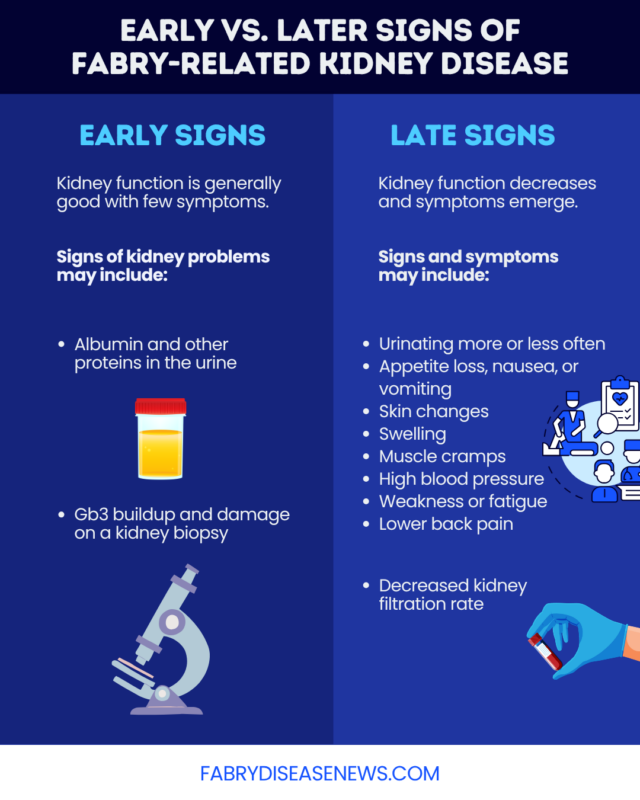
In the early stages of kidney disease, the kidneys are still working relatively well at filtering waste from the blood, so there are often no clear symptoms. However, doctors may see signs that Fabry is affecting the kidneys in clinical tests, including:
- proteinuria: elevated levels of proteins in urine
- albuminuria: a specific type of proteinuria involving the protein albumin
If routine tests identify proteinuria in patients with Fabry disease, doctors may order kidney biopsies, in which a sample of kidney tissue is collected and examined under a microscope. A biopsy can reveal other signs of damage, including:
- glomerulosclerosis, or scarring in the kidneys’ main filtering units (glomeruli)
- Gb3 accumulation in kidney cells
Even without bothersome symptoms, kidney damage might be progressing, so a doctor will likely recommend careful monitoring and possibly treatment at the first signs of a problem.
Other symptoms of kidney involvement
As Fabry disease and kidney damage, or nephropathy, progress, the kidneys’ filtering ability becomes increasingly impaired, leading to the accumulation of toxins in the blood. This can affect a range of bodily functions and lead to more substantial symptoms.
When they become apparent, Fabry disease kidney symptoms may include:
- changes in urinary frequency
- appetite loss
- dryness, itching, or discoloration of the skin
- swelling in the arms, hands, legs, or feet
- muscle cramps
- nausea or vomiting
- weakness and fatigue
- chest pain or shortness of breath
- headaches
- high blood pressure
- lower back pain
Not every person will experience all of these Fabry nephropathy symptoms. Each individual might develop any combination of these symptoms over time.
How Fabry-related kidney damage is diagnosed
People with an established diagnosis of Fabry disease typically undergo regular monitoring to identify any kidney problems early. Diagnostic tests for kidney damage in Fabry disease may include:
- urine tests: to identify proteinuria or albuminuria
- blood tests: to determine the estimated glomerular filtration rate (eGFR), an indicator of how well the kidneys are working to filter waste
- biopsies: to identify Gb3 buildup and related damage
People with chronic kidney disease without another established cause may also undergo diagnostic testing for Fabry disease if clinically indicated, including if there is a family history of Fabry disease or other Fabry symptoms are present.
How kidney involvement may progress over time
Kidney damage in Fabry disease is progressive, and without treatment, it typically worsens over time. Eventually, the damage may progress to end-stage kidney disease, or kidney failure, at which point the kidneys aren’t functional. This can substantially affect life expectancy in Fabry disease.
These changes are generally reflected by progressively declining eGFR values.
Scroll horizontally to view all columns -->
| Early
(Stage 1-2) |
Moderate
(Stage 3) |
Advanced
(Stage 4-5) |
|---|---|---|
| eGFR is normal or slightly low | eGFR has declined substantially | eGFR is very low |
| Kidneys are working well | Kidneys are not working as well as they should | Kidneys are close to not working or are not working |
| Often, there are no symptoms | Symptoms may emerge, or are still absent | More substantial symptoms are usually present |
The rate of progression of kidney disease in Fabry disease can vary widely. Factors that have been linked to slower Fabry disease kidney function declines include:
- female sex
- higher alpha-Gal A activity
- early use of disease-modifying therapies
- less proteinuria and higher eGFR
- late-onset Fabry disease
Treatments that help protect the kidneys
Treating kidney involvement in Fabry disease may involve a combination of Fabry-specific treatments to slow disease progression and supportive therapies to protect the kidneys from further harm. These treatments generally cannot reverse damage that has already been done, which is why early initiation is important.
Disease-modifying Fabry treatments include:
- Enzyme replacement therapy (ERT): Provides a working version of alpha-Gal A to promote Gb3 breakdown. Includes Elfabrio (pegunigalsidase alfa-iwxj) and Fabrazyme (agalsidase beta).
- Chaperone therapy: Aims to stabilize alpha-Gal A and make it more functional. Includes Galafold (migalastat).
There’s evidence that starting ERT early can help maintain kidney health and slow kidney decline. However, the benefits of ERT for the kidneys aren’t fully established, and many people still develop kidney problems in the long term. Galafold may also help slow kidney decline, but it is not recommended for people with advanced kidney disease.
Managing kidney problems in Fabry disease may also involve:
- blood pressure medications: angiotensin-converting enzyme inhibitors and angiotensin 2 receptor blockers can help control blood pressure changes and reduce proteinuria
- low-sodium diet: to help control blood pressure and swelling
When a person has reached end-stage kidney disease, interventions to replace lost kidney function are necessary. This may include dialysis, a procedure that filters waste products from the blood when the kidneys can’t. Some patients may also be eligible for a Fabry disease kidney transplant, which often improves long-term outcomes.
Living with Fabry and kidney involvement
Regular follow-up care with a kidney specialist, or nephrologist, is important for monitoring kidney health and treatment responses. Depending on the risk level and severity of kidney damage, specialists may recommend kidney monitoring, including blood and urine tests, every three to 12 months.
People living with Fabry disease should ask their doctors for more information about how Fabry disease affects the kidneys, what their follow-up schedule should be, and what lifestyle changes they should make to support kidney health. This could include:
- making dietary changes
- staying hydrated
- taking all medications as prescribed
- staying active
- quitting smoking
- managing stress
Various community support groups and online resources can also help individuals navigate how to deal with kidney problems in Fabry.
Fabry Disease News is strictly a news and information website about the disease. It does not provide medical advice, diagnosis, or treatment. This content is not intended to be a substitute for professional medical advice, diagnosis, or treatment. Always seek the advice of your physician or other qualified health provider with any questions you may have regarding a medical condition. Never disregard professional medical advice or delay in seeking it because of something you have read on this website.